

WELCOME

WELCOME

If students are Tolerant of others, they will accept other students’ differences, develop a healthy respect for one another and learn to live in a rich and diverse community. We also want all students to feel that this is their school and they belong here. Key information on ‘being tolerant’ is included below.

Tolerant

Showing willingness to allow the existence of opinions or behaviour that we do not necessarily agree with.

What is the another word of tolerant?

Other words that link to this are patient, benevolent, compassionate, broad-minded, charitable, sensitive to and receptive.

Examples of tolerant:

If you’re tolerant it means that you accept people who are unlike you or put up with stuff you don’t like. If you let your roommate play the same awful ’90s mix over and over and don’t say anything, you’re probably a very tolerant person. Broad-minded and open thinking is a hallmark of tolerant behaviour.

What is the difference between respect and tolerance?

In real-life terms, tolerance means accepting that something different has a right to exist, whether or not you agree with it, while respect means a high regard for that something.

Who is a tolerance person?

The definition of tolerant is a person who understands and accepts the different ideals and beliefs of others. An example of tolerant is three best friends who are Jewish, Christian and Muslim. These people clearly accept that each other have very different beliefs and faiths, yet they are able to be tolerant of this and remain friends.

Is tolerance always good?

When tolerance is placed within the moral domain relating to fairness, justice and respect and avoiding causing harm to others, it can only be viewed as a positive moral virtue.

Why is tolerance important in a relationship?

Tolerance helps to ease the pressure caused by problems. After all, tolerance is a key to understanding, and understanding is the force that holds long lasting relationships together. If you are tolerant of your partner/friend, then you have many ways to understand him or her.
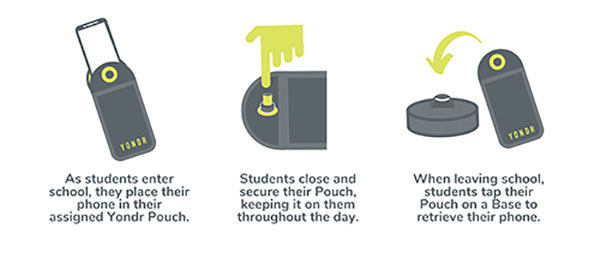
How Yondr Works

Frequently Asked Questions

We want our students to be engaged in their learning. A child at high school should not really have a reason to contact a parent during the day; however, if there is a genuine reason e.g. they have forgotten their packed lunch, a phone call can be made home from the school office. If a parent needs to contact their child in an emergency, they should contact the school office. If you need to contact your child during the school day, contact the main office on 01942 883796.

In case of a school emergency, we direct our students to safety first, following our school emergency procedures.


Students are in possession of their phone - in their Yondr pouch - for the entire school day. We will advise students to store the pouch safely in their school bag or blazer pockets.

If a student damages their Pouch or is caught on their phone, we will confiscate the phone and issue a sanction which is likely to be a suspension.

Note: Damage consists of any signs that the physical integrity of the pouch has been compromised, whether intentional or unintentional, as determined by the school or Yondr staff.

Damaged pouches will be charged to parents at a cost of £20.

They will be searched and wanded with a handheld scanner by a member of SLT. If they are found to have their phone on their person they will be expected to place it in their pouch. Refusal will be met with suspension.

If a student forgets their Pouch, their phone will be confiscated.

As per our previous mobile phone policy;

  • Confiscated phones will be taken to reception where the phone will be secured in the school safe.
  • Parents will be alerted to the phone confiscation via the school office.

Parents will have the option to collect the phone at the end of the day. If parents do not collect the phone, the phone will remain in school until the end of the week or until the student has their pouch.

In Yondr’s experience, this almost never happens. All students funnel past the unlocking stations at the exits, they want their phones back and don’t forget to unlock their pouches. If they do arrive home with a phone in a pouch, they can either come back to school to unlock it, or have a phone free evening!

The unlocking process is quick and takes under a second per student. 

As a privilege, Year 11 will be able to unlock their phones as they go off site at lunchtime; however, they will be expected to put their phones back into their pouches when they return to school for period 5.

Yes. There is an adapted version of the pouch which uses a Velcro fastener instead of a magnetic lock. This means the student still follows the policy, but the adapted pouch gives them easy access to their phone when required. If the student abuses this, they will face a sanction. We are already aware of these students.

Your Office 365 account username is your school network account username followed by @flhs.wigan.sch.uk 
The password is the same password that you use in school to access computers.