

WELCOME

WELCOME

General information

The school’s approach to SEND is informed by a commitment to high-quality teaching and our whole-school principle that provision needed by some learners can be beneficial to all.


Where appropriate, and in line with the Graduated Approach, the school may supplement its universal provision through the use of Student Support Profiles for students on the SEND register. These profiles are intended to identify barriers to learning and provide guidance on strategies that may support classroom practice.

How we support learners

At Fred Longworth High School, staff use adaptive teaching so that students can access the curriculum meaningfully. We take the view that most needs can be met through strong universal classroom practice, with additional adjustments made where staff judge them to be helpful and proportionate. There is no single template for support; staff select approaches that are suitable for the individual student and the learning context.

Examples of adaptations may include:

  • Purposeful seating arrangements, planned by staff to reduce barriers – for example, seating to minimise distractions, improve visibility/hearing, or support engagement. 
  • Curriculum adjustments, such as flexible grouping, targeted 1:1 tasks, or adapting lesson content or delivery, where staff feel this is appropriate. 
  • Adapting teaching approaches, for example:
    • front loading key vocabulary
    • providing additional processing time
    • reading instructions aloud
    • breaking tasks into clearly structured steps
  • Adjusting resources or staffing in ways that staff determine will support access to learning. 
  • Using recommended aids such as coloured overlays, laptops, or enlarged print where these are needed.

These approaches form part of our universal offer. Staff implement strategies that are needed for some students but are often beneficial to all.

Intervention Support

In addition to classroom strategies, some students may access intervention support where staff identify that a more targeted approach is appropriate. Interventions vary over time and are designed in response to current needs across the school. Sessions may take place individually or in small groups.

Examples of intervention areas:

In addition to classroom strategies, some students may access intervention support where staff identify that a more targeted approach is appropriate. Interventions vary over time and are designed in response to current needs across the school. Sessions may take place individually or in small groups.

  • Reading proficiency 
  • Numeracy support 
  • Social communication and interaction 
  • Emotional regulation 
  • Mental health and wellbeing 
  • Speech, language and communication 

Interventions are reviewed regularly to ensure students receive support that is timely, appropriate, and proportionate to need.
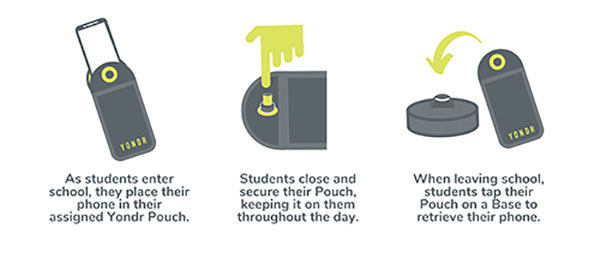
How Yondr Works

Frequently Asked Questions

We want our students to be engaged in their learning. A child at high school should not really have a reason to contact a parent during the day; however, if there is a genuine reason e.g. they have forgotten their packed lunch, a phone call can be made home from the school office. If a parent needs to contact their child in an emergency, they should contact the school office. If you need to contact your child during the school day, contact the main office on 01942 883796.

In case of a school emergency, we direct our students to safety first, following our school emergency procedures.


Students are in possession of their phone - in their Yondr pouch - for the entire school day. We will advise students to store the pouch safely in their school bag or blazer pockets.

If a student damages their Pouch or is caught on their phone, we will confiscate the phone and issue a sanction which is likely to be a suspension.

Note: Damage consists of any signs that the physical integrity of the pouch has been compromised, whether intentional or unintentional, as determined by the school or Yondr staff.

Damaged pouches will be charged to parents at a cost of £20.

They will be searched and wanded with a handheld scanner by a member of SLT. If they are found to have their phone on their person they will be expected to place it in their pouch. Refusal will be met with suspension.

If a student forgets their Pouch, their phone will be confiscated.

As per our previous mobile phone policy;

  • Confiscated phones will be taken to reception where the phone will be secured in the school safe.
  • Parents will be alerted to the phone confiscation via the school office.

Parents will have the option to collect the phone at the end of the day. If parents do not collect the phone, the phone will remain in school until the end of the week or until the student has their pouch.

In Yondr’s experience, this almost never happens. All students funnel past the unlocking stations at the exits, they want their phones back and don’t forget to unlock their pouches. If they do arrive home with a phone in a pouch, they can either come back to school to unlock it, or have a phone free evening!

The unlocking process is quick and takes under a second per student. 

As a privilege, Year 11 will be able to unlock their phones as they go off site at lunchtime; however, they will be expected to put their phones back into their pouches when they return to school for period 5.

Yes. There is an adapted version of the pouch which uses a Velcro fastener instead of a magnetic lock. This means the student still follows the policy, but the adapted pouch gives them easy access to their phone when required. If the student abuses this, they will face a sanction. We are already aware of these students.

Your Office 365 account username is your school network account username followed by @flhs.wigan.sch.uk 
The password is the same password that you use in school to access computers.